EV Charger Tester(EV Simulator) – Full Coverage of EV Charging Standards
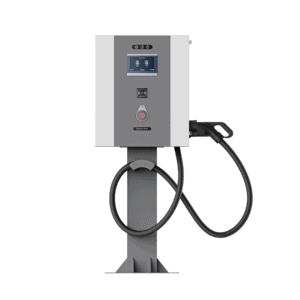
This dual-interface EV Charger Tester(EV Simulator) supports all major EV charging protocols, including GBT, CCS1, CCS2, CHAdeMO, and NACS. Designed with dual sockets, it allows simultaneous dual-gun testing, and can operate with both built-in and external loads. The 7-inch touch LCD screen and backlit keys make operation intuitive and easy.

Product Features
- Dual ports detection
- Charging voltage detection
- Charging current detection
- EVCC/BMS communication test
- Charging fault protection test
- Automatic charging test
- Message control function
- Charging pile aging test
- With 4 moving wheels
- With resistive loads
Charger Tester (dual interface)
Category | CCS1/CCS2 | NACS(Tesla) | GBT | CHAdeMo |
User interface language | English | |||
Operating Voltage | AC230V±20% | |||
Display | 7-inch touch screen | |||
Operating temperature | -30℃-70℃ | |||
Size | 800mm x 600mm x 1100mm | |||
Weight | 170 kg | |||
Detection object | CCS1/CCS2 DC charger | NACS(Tesla) DC charger | CHAdeMO DC charger | GBT DC charger |
Socket | CCS1/CCS2 | NACS(Tesla) | CHAdeMO | GBT |
Built-in resistor rod power | DC15kW+AC7.5kW | DC15kW | 15kW | 15kW |
Built-in maximum test | DC15A+AC10A | DC15A | DC 15A | DC 15A |
Current gear | 5A,10A,15A | |||
Maximum test output | DC1000V+AC400V | DC1000V | DC1000V | DC1000V |
Maximum test current | 200A | 200A | 200A | 200A |
Parts List | 1 set of AC220V input power cord;2 sets of external load positive and negative connection plugs | |||
FAQ
Is there a user manual available?
Yes, a digital copy is provided with every purchase
Is installation required for this product?
No, the unit is plug-and-play.
Does the device provide a complete list of error codes and troubleshooting steps for faults detected during testing?
The tester is designed to simulate a standard Electric Vehicle (EV) to evaluate charging station performance. If a fault occurs, the charging station will trigger a specific error message or code.
Can the load be set in specific kW steps?
The load is not set directly in kW. Instead, users can independently configure the Target Voltage and Target Current on the tester interface to achieve the desired power output.
What parameters are adjustable, and what is the resolution/step size?
- The display interface allows for precise input of voltage and current. The adjustable ranges are:
Voltage: 1V – 1000V
Current: 1A – 250A
The charging station will provide output based strictly on these set parameters and will not exceed these limits.
How do I limit the output to lower power levels (e.g., a 6 kW office supply limit)?
You can limit the output to around 6 kW by setting the appropriate voltage and current on the test device.
For example, you may set:
Voltage: 400V
Current: 15A
This results in approximately 6 kW (400V × 15A ≈ 6000 W).
Since the test device simulates an EV, it requests the desired voltage and current, and the charger will not exceed these values. You can use the load buttons to gradually increase the current while ensuring the total power remains within your facility’s capacity.
Does BESSUN offer other models with higher load capacities (e.g., 30 kW, 60 kW, or higher) for advanced testing?
Yes. While the standard unit includes a built-in resistor load for basic verification, the system is designed for high-power scalability. By utilizing the extended load connectors, the tester can support external loads of up to 200 kW. This allows for full-scale stress testing and aging tests of high-speed DC chargers.
Can the BSD-TE1 generate specific fault scenarios (e.g., insulation faults, communication errors, or emergency stop simulations) to test charger protection?
Currently, the BSD-TE1 focuses on simulating standard EV charging behaviors and load verification. While it does not support the manual injection of fault scenarios like insulation or communication errors at this time, these features are under consideration for future hardware or firmware updates.
Does the tester include PC software for analyzing CAN/PLC communication logs?
At present, the device does not come with dedicated PC analysis software for protocol logging. We recommend using standard external diagnostic tools if deep-packet analysis of the CAN or PLC bus is required.
What are the shipping dimensions and weight for the BSD-TE1?
The unit is shipped in a protective wooden box with the following specifications:
Dimensions: 1020 x 720 x 1150 mm (40.2 x 28.4 x 45.3 in)
Gross Weight: 185 kg (407.9 lbs)
What is the standard production lead time for the BSD-TE1?
The standard production lead time is 25–30 days from the date of order confirmation and deposit receipt.
What kind of warranty is provided?
We provide a 1-year limited warranty covering all manufacturing defects. Technical support and replacement parts are available during this period.