
What Is a Swing Arm for EV Charging Stations?
A Swing Arm for EV charging stations is a pivoting mechanical support that carries part of a charging cable’s weight and guides its movement between the charger and the vehicle. It is one type of EV Charging Cable Management System (CMS), used where heavy cables are difficult to lift, position or return after charging.
The arm provides a supported path for cable movement. Its usefulness depends on the cable, mounting structure and area it needs to reach. Supporting the cable can make handling easier, but it does not remove all cable weight or guarantee ground clearance in every position.
1. How Does a Swing Arm Work?
The arm pivots at its mounting point and may include additional articulated joints. As the user moves the connector towards the vehicle, these joints let the supported cable change direction within the arm’s working area. The available rotation depends on the design, installation and surrounding clearance.
Where the configuration includes spring assistance, the mechanism offsets part of the supported load. The cable still needs to move freely without excessive tension at the connector or charger outlet. A cable clamp and connection assembly transfer the load to the arm.
A flexible, or soft, connection permits more relative movement. A direct, or hard, connection provides more control at the attachment point but transfers pulling forces more directly. These arrangements must suit the selected arm and cable.

2. Why Use a Swing Arm for DC Fast Charging?
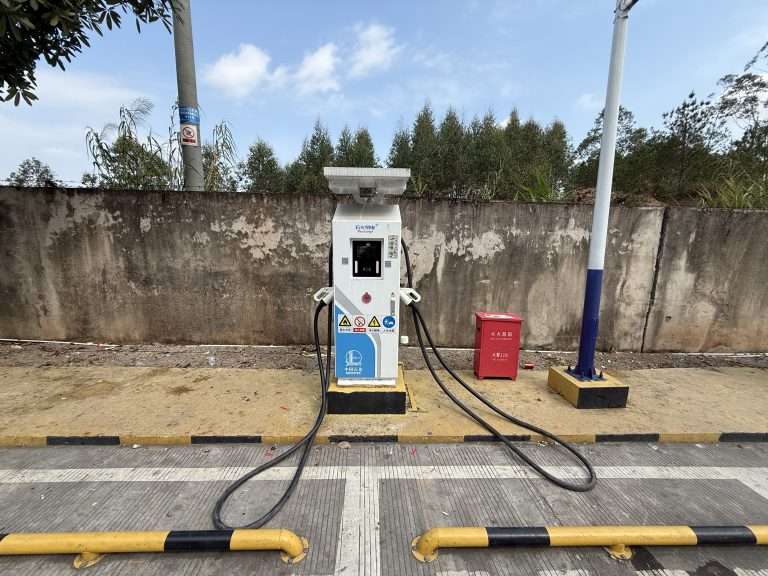
Thick or heavy DC charging cables can be awkward to move, particularly when the vehicle inlet is some distance from the charger. Suitable support can help with:
- Handling effort: carrying part of the cable load while the user positions the connector.
- Cable dragging: reducing unnecessary contact with abrasive ground surfaces.
- Routing: giving the cable a more controlled path around the charger.
- Bending and twisting: allowing movement without forcing the cable around unsuitable corners.
- Return and storage: providing a more convenient position for the cable after use.
These are practical design aims, rather than guaranteed outcomes for every installation. Check the full movement with the actual cable, including the furthest charging position and the return path. A Swing Arm does not replace cable inspection or site-specific accessibility assessment.
3. Typical Applications
Swing Arms can be considered for public DC fast charging stations, fleet depots and bus or truck charging facilities. High-power installations may benefit where cable mass and stiffness make repeated handling difficult. Suitability depends on the charger structure, vehicle inlet positions and available movement space, rather than the application name alone.
4. Key Engineering Considerations
- Cable diameter: match the clamp to the measured outer diameter and cable construction.
- Length and weight: establish the supported cable load, including relevant connector weight, rather than selecting by length alone.
- Mounting position: confirm the charger panel or separate support can carry the operating loads.
- Working range: map the vehicle inlet positions and the cable path needed to reach them.
- Movement clearance: check the arm and cable against adjacent chargers, vehicles and access routes throughout travel.
- Cable routing: respect the cable manufacturer’s bend-radius requirements and avoid unwanted loads at the outlet.
4.1 Working Load and Maximum Load
Working load is the recommended load for normal operation. Maximum load refers to a limit under defined conditions, which may specify a distance from the mounting axis. The two are not interchangeable. A model-specific maximum-load test is not a universal operating rating for every Swing Arm or installation.
4.2 Connection and Clamp Compatibility
Select the swing arm, connection and clamp as a compatible assembly. In BESSUN’s current range, BSM-SA1, BSM-SA2 and BSM-SA4 offer soft or hard connections. BSM-SA5 uses a soft connection, while BSM-SA3 requires its dedicated connection and clamp components.
For model-specific configuration choices, see the Swing Arm selection guide.
5. Swing Arm vs Cable Retractor vs Spring Balancer
- Swing Arm: a pivoting or articulated structure supports and guides the cable. It needs suitable mounting strength and room for the arm to move.
- Cable Retractor: a spring mechanism applies force through a retracting rope attached to the charging cable. Selection depends on retraction force, available rope travel and cable compatibility.
- Spring Balancer: BESSUN’s vertical spring-assisted support follows the cable direction during use. Spring configuration and mounting arrangement must match the cable load and required movement.
Some designs combine functions, so the product name alone is not enough to specify a system. For a broader comparison, use the EV Charging Cable Management Selection Guide.
6. Learn More About BESSUN Swing Arms
BESSUN specializes in EV Charging Cable Management Systems. For current configurations, specifications and installation information, visit the BESSUN Swing Arm product page.
For a technical discussion, provide the cable diameter, length and weight together with charger drawings, mounting position and required working range. These details allow the proposed assembly to be assessed against the actual charging layout.